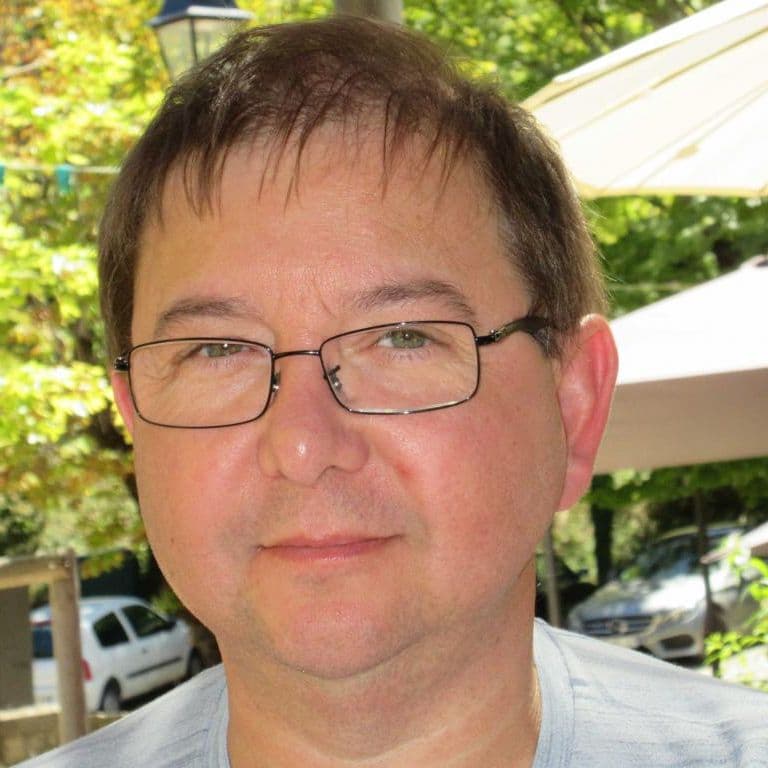
Dimitri Pourbaix
xx xx, xxxx - xx xx, xxxx
Dimitri Pourbaix was a kind, passionate and enthusiastic person. He was a senior FNRS research associate (Maître de recherches FNRS) at Université libre de Bruxelles. He maintained the 9th Catalogue of Spectroscopic Binary Orbits (SB9) for the former IAU Commission 26. He has been president of the IAU Commission 30 (Radial Velocities). He was passionately involved in the Gaia space mission, particularly in connection to issues related to binary stars. He enjoyed sharing his passion with the public through lectures at ULB and astronomy camps in the Ardennes.
Condolences
Salim ANSARI
I am very sad to hear about the passing away of Dimitri. We had great talks in the early days of Gaia. Dimitri was always enthusiastic about trying our new technologies, and was more than willing to participate in our initiatives. I will miss you Dimitri.
Luigi "Rolly" BEDIN
What a sad news. :( I am going to miss you a lot Dimitri. You were my reference for astrometry of binaries. I was going to send you a draft about our Luhman16 project. Sigh. Farewell Dimitri, you were a great Astronomer, a great Scientist, and a good person! Rolly
Gabriel Bihain
Mes sincères condoléances à la famille de Dimitri. Je garde en mémoire la bonne humeur de Dimitri et sa grande expertise sur les étoiles binaires.
Rene Mendez
I am a newcomer into binary star research. Despite this, when i first approached Dr. Pourbaix for guidance on various aspects related to the use oh his SB9 catalogue, he was always diligent, kind, and pedagogical. I am very sorry for his sudden departure. I humbly dedicated my latest paper on double line spectroscopic binaries (with my student Mrs. Jennifer Anguita-Aguero) to the memory of Dr. Pourbaix. I hope that one his greatest legacies as service for the world-wide community of binary research, namely, the SB9 catalogue, will be continued by some of his disciples. With kind regards, Rene A. Mendez (University of Chile).
Alain Jorissen
In recognition of Dimitri Pourbaix's astronomical achievements, an asteroid has been named after him : (374715) Dimpourbaix = 2006 SH20 https://www.wgsbn-iau.org/files/Bulletins/V001/WGSBNBull_V001_013.pdf
sabine
Mon Cher Dimitri, chaque fois que je pose mon regard sur la coupole j’ai une pensée pour toi. Aujourd’hui cette pensée prendra un autre sens, un hommage à tout ce que tu as réalisé avant de nous quitter. A ta famille j’adresse mes sincères condoléances.
Alain Jorissen
Hommage officiel présenté au conseil de la Faculté des Sciences ULB (novembre 2021). English translation below Dimitri Pourbaix naît à Charleroi le 22 mai 1969. Vers 15 ans, sa double passion pour les calculs astronomiques et l’informatique se manifeste déjà clairement lors de sa participation aux stages d’astronomie organisés par l’asbl Jeunesse et Science, dont il deviendra plus tard un acteur majeur en organisant les stages d’astronomie pour adultes. A cette époque, il ne passait pas inaperçu car il se déplaçait déjà avec tout son arsenal informatique, soutenu dans sa passion par un père informaticien. C’est donc tout naturellement qu’il réussit une licence en informatique à l’Université de Liège et qu’il y entreprend sa thèse de doctorat. Après un séjour doctoral à l’Université de Floride (août 1996 – mai 1997), il revient en Belgique pour terminer sa thèse à l’Observatoire Royal de Belgique. Sa thèse en astrophysique était consacrée à l’automatisation des calculs d’orbites d’étoiles binaires par une technique de minimisation globale, une première à l’époque. Il rejoint alors notre Université (octobre 1998), d’abord sur un contrat PRODEX (ESA/BELSPO) et devient respectivement en octobre 2000 Chargé de Recherches, en 2002 Chercheur Qualifié et passe ensuite Maître de Recherches du FNRS. Il effectua plusieurs séjours de courte durée à l’Université de Princeton. Ses recherches portaient à cette époque sur l’application de sa méthode de calcul d’orbites pour le re-traitement des données acquises par le satellite Hipparcos de l’ESA. Sa maîtrise du sujet le font rapidement remarquer par l’ESA. La communauté scientifique associée à Gaia au sein de l’ESA le nomme responsable de l’une des neuf divisions de traitement des données livrées par le satellite Gaia, l’”arpenteur de l’Univers”, le successeur d’Hipparcos. Gaia, lancé en décembre 2013, vise à cartographier 2 milliards d’étoiles de notre Galaxie, et le rôle de Dimitri Pourbaix est d’y repérer les étoiles binaires ou multiples. Un projet enfin à la mesure de ses ambitions. Il s’y attellait déjà depuis une dizaine d’année avant le lancement, mais il n’aura pas le temps de tirer le parti scientifique de ses efforts numériques considérables, loués par tous ses collègues du consortium Gaia, car les complications de son opération cardiaque l’emportent ce dimanche 14 novembre 2021, moins d’un an avant la publication du catalogue pour lequel il aura déployé tant d’efforts. C’est désormais le rôle de ses collègues de lui rendre hommage en effectuant cette analyse en sa mémoire. Il devient maître d’enseignement en octobre 2010 pour le cours INFO-F-207 (« Informatique » pour les BA2 Physique et Mathématiques). En octobre 2013, il prend partiellement en charge le cours PHYS-F-204 (« Projet de recherche et communication scientifique », alias « Printemps des Sciences ») puis en octobre 2014 il participe aux cours PHYS-F-514 « Didactique de la physique » et PHYS-F-515 « Pratique Réflexive ». Dimitri était particulièrement attaché à la représentation de notre Département à l’extérieur par sa présence systématique au salon SIEP et son engagement dans la formation des étudiants au Printemps des Sciences. Il occupait également la présidence de la commission finances du département de physique, et était responsable des commandes de livres pour ce même département. Dimitri était un infatigable diffuseur de savoirs qui ne ménageait jamais ses efforts, tant pour les transits de Vénus, les soirées d'observation à la coupole astronomique de l’ULB, le cours public d'astronomie, Parentville ou l'association Jeunesse et Science. Dimitri était homme de principes, une illustration en est donnée par l’auteure Elisa Brune, qu’il rencontra lors des stages d’astronomie pour adultes de l’asbl Jeunesse et Science, dont il assurait la logistique. Elisa Brune écrit (Les Jupiters chauds, Belfond, 2002, p. 394) : « Quand j’arrivai à l’hôtel, je tombai sur Dimitri qui rentrait au même moment. Nous convînmes d’aller boire un dernier verre au bar de l’hôtel – je m’étonnai seulement quand je m’aperçus qu’il s’agissait pour lui d’eau pétillante. Lui, si amateur de bières belges qu’il parvenait à se fournir dans les marques les plus improbables même lorsqu’il travaillait à Princeton. - Pas pendant un colloque, trancha-t-il, c’est un principe. » Nos pensées se tournent aujourd’hui vers son épouse Sophie et son fils Charlie. * * * Dimitri Pourbaix was born in Charleroi on 22 May 1969. At the age of 15, his double passion for astronomical calculations and computer science was already evident when he took part in astronomy camps organised by the non-profit organisation Jeunesse et Science, of which he would later become a major actor by organising astronomy camps for adults. At that time, he did not go unnoticed because he was already moving around with all his computer arsenal, supported in his passion by a computer-scientist father. It was therefore quite natural that he obtained a degree in computer science at the University of Liège and that he undertook a doctoral thesis in astrophysics in Liège as well. After a doctoral stay at the University of Florida (August 1996 - May 1997), he returned to Belgium to complete his thesis at the Royal Observatory of Belgium. His thesis was devoted to the automation of binary-star orbit calculations using a global minimisation technique, a first at the time. He then joined Université libre de Bruxelles (October 1998), first on a PRODEX contract (ESA/BELSPO) and became respectively in October 2000 Chargé de Recherches, in 2002 Chercheur Qualifié and then Maître de Recherches of FNRS (National Fund for Scientific Research). He made several short stays at Princeton University. At that time, his research focused on the application of his orbit calculation method for the re-processing of data acquired by ESA's Hipparcos satellite. His mastery of the subject quickly brought him to the attention of ESA. The scientific community associated with Gaia within ESA appointed him to head one of the nine divisions (namely CU4) processing Gaia-satellite’s data, the 'surveyor of the universe', succeeding to Hipparcos. Gaia, launched in December 2013, aims to map 2 billion stars in our Galaxy, and Dimitri Pourbaix's role is to identify binary or multiple stars. This project is finally commensurate with his ambitions. He had already been working on it for about ten years before the launch, but he will not have the time to take full scientific advantage of his considerable numerical efforts, which have been praised by all his colleagues in the Gaia consortium, because complications from his heart operation will take his life on Sunday 14 November 2021, less than a year before the publication of the catalogue for which he has worked so hard. It is now the role of his colleagues to pay tribute to him by carrying out this analysis in his memory. Besides his leading role in Gaia CU4, Dimitri played important roles within the IAU as well : - Dimitri Pourbaix was the newly elected Vice-President of IAU Commission G1 on Binary Stars ; - He was the manager of the 9th catalogue of orbits of spectroscopic binaries for the former IAU Commission 26 (now G1) ; - Past Steering Committee Member of Division A Fundamental Astronomy (2012-2015) ; - Past President of the former IAU Commission 30 (Radial Velocities) (2012-2015) ; - Past Chair of Commission 26 WG Catalog of Orbital Elements of Spectroscopic Binary Systems (until 2015) ; - Past Organizing Committee Member of Commission 26 Double & Multiple Stars (2006-2012). Dimitri was a tireless disseminator of knowledge who never spared his efforts, whether it was for the transits of Venus, the observation evenings at the ULB astronomical dome, the public astronomy course at the University, or the « Jeunesse et Science » association. Dimitri was a man of principles, as illustrated by the author Elisa Brune, whom he met during the astronomy camps for adults organised by the Jeunesse et Science association, for which he was responsible for the logistics. Elisa Brune writes (Les Jupiters chauds, Belfond, 2002, p. 394): 'When I arrived at the hotel, I bumped into Dimitri who was returning at the same time. We agreed to go for a nightcap in the hotel bar - I was only surprised when I realised that he was drinking sparkling water. He was so fond of Belgian beers that he managed to buy the most unlikely brands even when he was working at Princeton. ’ - « Not during a conference, he told me, it's a principle. » He was a dedicated husband and father of a young son.
Tineke Roegiers
My sincere condolences to the family. It is really sad to hear Dimitri passed away. We so wished for his recovery so he could celebrate Gaia's first release of non single stars and see the result of his work towards this catalogue. I'm sure many of us will think of him while presenting the binary stars for Gaia's third data release.
Page 1 of 7