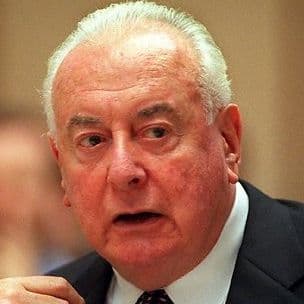
Gough Whitlam
xx xx, xxxx - xx xx, xxxx
Edward Gough Whitlam was an Australian politician who was the 21st Prime Minister of Australia from 1972 to 1975 and the Leader of the Labor Party from 1967 to 1977. Whitlam led Labor to power for the first time in 23 years at the 1972 election; he went on to win the 1974 election before being controversially dismissed by Governor-General Sir John Kerr at the climax of the 1975 Australian constitutional crisis. Whitlam remains the only Australian Prime Minister to have his commission terminated in that manner. Whitlam was first elected to Parliament in 1952, representing Werriwa in the House of Representatives. He became Deputy Leader of the Labor Party in 1960, and in 1967, after the retirement of Arthur Calwell, he was elected Leader and became the Leader of the Opposition. After narrowly losing the 1969 election, Whitlam led Labor to victory at the 1972 election after 23 years of continuous Liberal-Country Coalition Government. The Whitlam Government implemented a large number of new programs and policy changes, including the termination of military conscription, institution of universal health care and free university education, and the implementation of legal aid programs. With the Opposition-controlled Senate delaying passage of bills, Whitlam called a double-dissolution election in 1974 which he went on to win, albeit with a slightly reduced majority. However, the Opposition continued to control the Senate, and reacting to government scandals and a flagging economy, continued to challenge Whitlam. In late 1975, the Senate delayed the progress of appropriation bills, thus denying the Government supply. Whitlam refused to back down, arguing that his elected Government was being held to ransom by the Senate. The crisis ended on 11 November, when Governor-General Sir John Kerr controversially dismissed Whitlam and commissioned Opposition Leader Malcolm Fraser as Prime Minister on the understanding that he would pass the Supply bills and advise a general election. Labor lost the subsequent election by a landslide. Whitlam stepped down after losing again at the 1977 election, retiring from Parliament in 1978. Upon the election of the Hawke Government in 1983, he was appointed as the Australian Ambassador to UNESCO, and remained active into his nineties. Although his last years were spent in a Sydney retirement home, he still attended his office up to three days a week, until his death on 21 October 2014. The circumstances of his dismissal as Prime Minister, and the legacy of his government, remain a large part of Australian political discourse.
Condoleances
Aaron James
My condolences go out to the family. I am so sorry too hear of the lost of a dear loved one to this family. Dealing with this situation can be the hardest thing to face. God's word the bible gives heartfelt and true meaning for ones sleeping in death; Revelation 21: 3,4 says: 3 With that I heard a loud voice from the throne say: “Look! The tent of God is with mankind, and he will reside with them, and they will be his people. And God himself will be with them. 4 And he will wipe out every tear from their eyes, and death will be no more, neither will mourning nor outcry nor pain be anymore. The former things have passed away.” God also promises a hope for ones to have life again at John 5: 28,29a : Do not be amazed at this, for the hour is coming in which all those in the memorial tombs will hear his voice 29 and come out. Visit Jw.org for more encouraging bible truths.