Dhirendra Kishore Verma
xx xx, xxxx - xx xx, xxxx
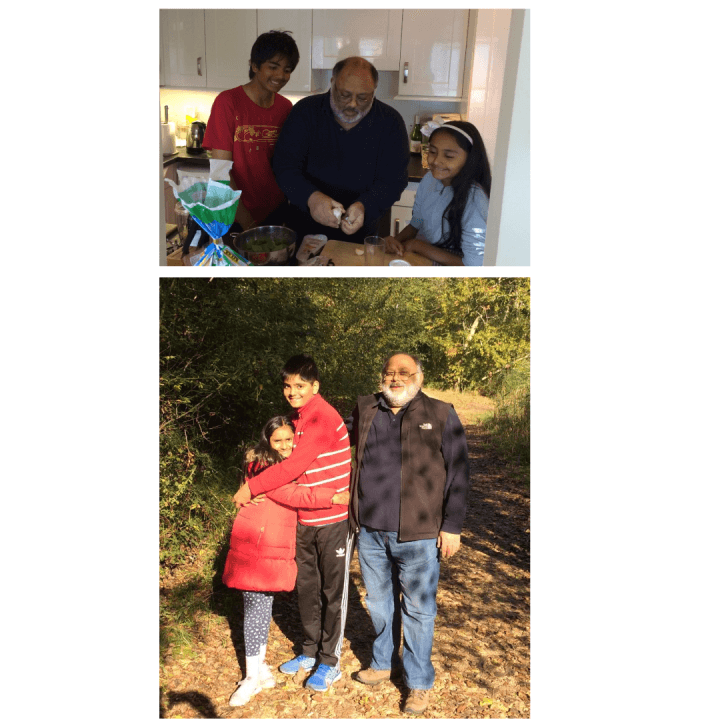
Dhiru, also known as "Kishore" to his many friends and family was born in Patna, India in 1962. He would often speak fondly of a carefree childhood in Hyderabad, Bikapur and Bhagalpur spent with his cousins and uncles. In 1970, Dhiru and his family moved to York to start a new life. During his formative years he developed a range of interests, including photography, literature, and science. Dhiru was always one to want to work and make his own way. He worked in a model aeroplane shop while at school, developing a lifelong love for aeronautics. Life in the 1970s for an Asian family in York was no doubt challenging and it left its impression on Dhiru. While studying in London, Dhiru made lifelong friendships. He then spent over a decade abroad living in Spain, France, Poland, and Germany teaching English and creating drama productions. He taught at the Centro Dramatico Nacional in Madrid and established the Cacco Perro theatre company. He produced Peter Weiss's "Marat/Sadfe", Fassbinder's "Blood on the Cat's Neck" and Valle-Inclan's "Silver Face". After moving to Lodz, Poland in the mid 1990's he directed Fassbinders' "Pre-Paradise Sorry Now". He directed animation sequences on the short experimental film 'Death in the Labyrinth' which was judged Best Experimental Film at the Krakow Film Festival. He often recalled his years of travelling and working in theatre as some of his happiest. On returning to England he completed a Masters’ degree at Sheffield Hallam University and he worked as a lecturer in film studies at Royal Holloway College, University of London and Southampton Solent University, where he was much loved and respected by many of his students. During this time he directed 'Enfant Terrible' (2005), which won a Special Mention Jury Prize at Barcelona and La Realisation Integrale award at Paris. He also served as the Director of the New York Film Academy, London, and went to Cuba and Turkey to give workshops on cinematography on behalf of the British Council. After suffering a stroke in 2016 and subsequent kidney failure, he moved to Sheffield in 2021 to be with his family. We were very lucky to have him close to us for this time. Dhiru was a deeply thoughtful and intelligent person. He loved nothing more than reading and thinking about topics ranging from physics to politics to philosophy and everything in between. We will remember him most for the tremendous kindness and care which he showed to the great many people who he met along his journey, in particular his love for his mother, father, brothers and his niece and nephew, Anjali and Satyam, which was something that shone a light in his life and made him so happy. We will all miss him tremendously.
Condoleances
- K
Thank you, Kishore. You were kind and compassionate, and you welcomed me into Royal Holloway with an understanding of my circumstances. Your decision to accommodate me and give me a chance changed the trajectory of my life, and I will always be deeply grateful. This goes back to 2009, but I have often wanted to reach out simply to say thank you. I am saddened that, after searching for your name to do just that, I have only now learned of your passing. I’m sorry I didn’t express this sooner. My heartfelt condolences to your family and loved ones. With love and gratitude.
Małgorzata and Mariusz
Byłeś niezwykłym człowiekiem. Nigdy Cię nie zapomnimy.
Jackie Marty
I was shocked to hear of Kishore's passing, I had the pleasure of working with Kishore for many years at Royal Holloway and have some very fond memories of that time. He was passionate about what he taught and was respected by colleagues and students alike. RIP Kishore.
Fernando Gonzalez Oset
Now that I know I won't be able to attend Kishore's funeral, I feel I owe him a few words of farewell. I'd like to share them with you. Since I'm not fluent in English, I've used Google Translate. Please excuse me if there are some fragments that are not entirely intelligible. I met Kishore in the early 1990s. We both had studies and long stays abroad under our belts and were genuine film addicts. We had attended the Lodz Film School so we could make our films in the place where the careers of Polanski, Wajda, Kieslowski and many others had begun. Poland was then a post-communist country, still closed to the rest of the world, with many peculiarities that were difficult for us to adapt to at first. What impressed me about Kishore was his absolute command of Spanish (including Madrid slang) and his electric, passionate, and tireless character. He would give up hours of sleep to devote to his countless projects. He soon created an English-language radio show, the first of its kind on the city's radio station. Later, he joined a group of young actors to found an independent theater group. And in parallel with these and many other activities, which I cannot possibly list, he was an idea-producing machine. Kishore had extensive knowledge of science, technology, computer science, drama, cinematography, acting, literature, philosophy, and politics. Without being an expert in any of these subjects, he was able to establish connections between them and, through extrapolation and intrapolation, created synergies that he put to the service of his true passion: cinema. In this way, he constantly came up with new ideas for films, all with an unmistakable stamp of originality, some of them bordering on genius. But his restless nature led him to abandon them after a short time, because he had already fallen in love with the next one. One in particular stayed with me because I insisted that he develop it. It was a dystopia in the style of Jean-Luc Godard's "Alphaville." The philosophical overtones of the plot were based on Wittgenstein's premise that the limits of language mark the limits of the world. To put it another way: anything that doesn't have a name doesn't exist. The plot unfolds in a future society governed not by money but by words. The protagonist is a private detective who arrives in a decaying city called Campofrío following the trail of a word smuggler. He encounters a frightened population in a state of alarm. The city is subject to constant change. Every time a word is privatized, what it names disappears, be it a building or an object of everyday use. There are also disconcerting apparitions, strange objects whose purpose and reason for being defies all reasoning. Everything is fleeting in that imaginary world, where words equal power and are quoted on the stock market. Quite a while ago, Kishore confided in me the reason he abandoned the project. Every time he tried to develop it, he felt like he was mutilating the original idea; he never felt the same way he did at the moment of its genesis. It is no surprise then that all the theatre and film projects he completed were based on other people's works or scripts. Their own ideas were so precious to him that he preferred to leave them unfinished rather than risk sullying them. Kishore had a contradictory personality. On the one hand, he felt a strong attraction to human cruelty and a profound contempt for its stupidity. On the other hand, he displayed a profound and unusual empathy for his fellow human beings. That's why I used to jokingly call him a sentimental sadist. He once replied that I knew him best of all his friends. I asked him then to express his contradictions in his creative work without attempting to reconcile them rationally. Perhaps my suggestion came too late or was a daunting task, one he didn't feel up to. What I do know is that I would have loved to see Kishore's complex personality reflected in a work of art. Of all the mistakes an artist can make, the most common is wanting to be liked, trying to please everyone in every way, seeking universal approval at all costs. Kishore opted for the opposite: he wanted to be hated, to provoke, to hold an aberrant mirror up to the audience and say, "See? That's how stupid and evil you really are." He participated in a Polish independent theater festival with a Fassbinder play that until then had been considered unstageable due to its high level of violence. When the performance was interrupted by the organizers before its conclusion, Kishore celebrated it as a great triumph. He was exultant. We both rolled around laughing, remembering the festival director giving explanations and a somewhat naive audience member who demanded the play be restarted because she wanted to know how it ended. Kishore used to say of his home country, India, that it was like a broken mirror, each of its fragments reflecting a different part of the rest of the world. I believe this powerful metaphor also applies to Kishore's own complex personality. I sense that each of us who were fortunate enough to know him and enjoy his friendship only knew a part of him, and that only by piecing together all the fragments would we gain an accurate view of his personality. In his last year of life, already suffering from serious health problems, he told me that his only regret was not having the strength to pursue creative work and not being able to maintain as much contact with his friends as he would have liked. For my part, I can only say that each of the messages from Kishore I received, increasingly sporadically, brightened my day, that it was an honor to have known him, and that I will miss him very much. Without his irony, his sensitivity and his unique way of looking at the world my existence would be a little poorer. Turning Wittgenstein's assertion on its head, I would affirm that what has a name must necessarily exist, and that Dhirendra Kishore Verma will continue to exist in a privileged place in the memories of all of us who knew him.
Narinder Khatri
"Dhiru was an incredible person who radiated positivity and life. Though recent illnesses had affected him, his spirit remained unbroken. He'll be deeply missed, and his memory will live on in our hearts. Rest in peace, Dhiru"
Peter Jan Cartwright
It’s hard for me to write these words as it’s hard for me to believe Kishore is gone, just over a week before his passing we were very much still in touch, discussing new camera equipment and ideas and making silly jokes. He looked and sounded better, which made discovering the sad news such a shock. During my time in education we shared a love for the films made by Sergio Leone and Sam Peckinpah, but he also open my eyes to the works of Fassbinder and Kieslowski and helped nurture me in the ways of story telling and really made me think what it was all about, why this shot? why this movement? and fundamentally what was the story about? Which frustratingly I always found hard to answer. He was a wonderful human being who didn’t hesitate to share his time and knowledge. It fills me with regret that I didn’t see him more often then I did but I appreciate so much more now the time we did talk, laugh, eat and drink.
Yasmin Verma
Meri yadeen,jo Dhiru ke saath,mere Airindia dino ki hain woh sab toh bas choti si meethi si hain.Sabse accha laga tha jab woh meri aur Ravi ki sashti purti ke liye prashant ke saath aaya tha.Humlog eak Resort mein gaye the, Dinesh mausa and Seema mausi bhi thee .He was so Happy and enjoyed thoroughly as he mixed with everyone Immediately and entertained everyone with his wit.He came back to Mumbai,stayed with us ,enjoyed and said ,he would love to come back and live in Mumbai.That short period will remain entrenched in my living memories of Dhiru
Gandhis
Dhiru: A one-in-a-generation blending of intelligence, affection and humbleness. We shall always cherish your sweet memories in our hearts.
Pagina 1 van 5